

To accurately answer the question What is Query Fan-Out, we must first look at the evolution of search engines. In traditional search, the user would enter a phrase and the search engine would display pages based on that phrase that were relevant in terms of keywords, links, and ranking signals. But in modern search, systems are no longer focused on just one term. They expand the question, turn it into several branches and try to answer it from different angles.
So if we want to say exactly what Query Fan-Out is, we should say:
- Query Fan-Out is a process in which a main query is transformed into a set of sub-queries, related intents, side questions and information retrieval paths to produce a more comprehensive, accurate and multi-dimensional answer.
For example, if a user searches:
“Best SEO Strategy for AI Search”
The system may split this query into several sub-paths, such as:
- What is AI Search?
- How has SEO changed in response-oriented engines?
- What is the role of E-E-A-T in AI Search?
- What is the use of Query Fan-Out in information retrieval?
- How to optimize content for Zero-Click Search?
This is where understanding Query Fan-Out becomes important. Because now a page is no longer ranked just by repeating a keyword; Rather, it should be able to cover several intentions and several information paths at the same time.
Why is it important to understand Query Fan-Out?
When we ask What is Query Fan-Out, we should immediately ask why this concept is important. The importance of Query Fan-Out comes from the fact that search behavior and the way search engines respond have changed. Users are no longer just looking for a link; They are looking for accurate, fast, hybrid and reliable answers.
Reasons why Query Fan-Out is important
1. Better understanding of search intent
One of the main benefits of Query Fan-Out is that it helps the search engine better understand the true intent of the user. A question can have several meanings, several layers and several goals. Query Fan-Out handles this complexity.
2. Produce a more comprehensive answer
If we understand Query Fan-Out, we will understand why response-oriented engines can answer a query from multiple sources and multiple angles. Because they divide Query into smaller branches.
3. Direct impact on content strategy
In modern SEO, it is no longer enough to focus on just one keyword. Knowing what a Query Fan-Out is helps you create content that also covers all of the user's sub-queries.
4. Improved visibility in AI Overviews and smart results
New engines usually use content that has good topic coverage to build a composite response. Therefore, understanding Query Fan-Out can increase your chances of appearing in these results.
جهت راهنمایی و مشاوره کلیک کنید.

How does Query Fan-Out work?
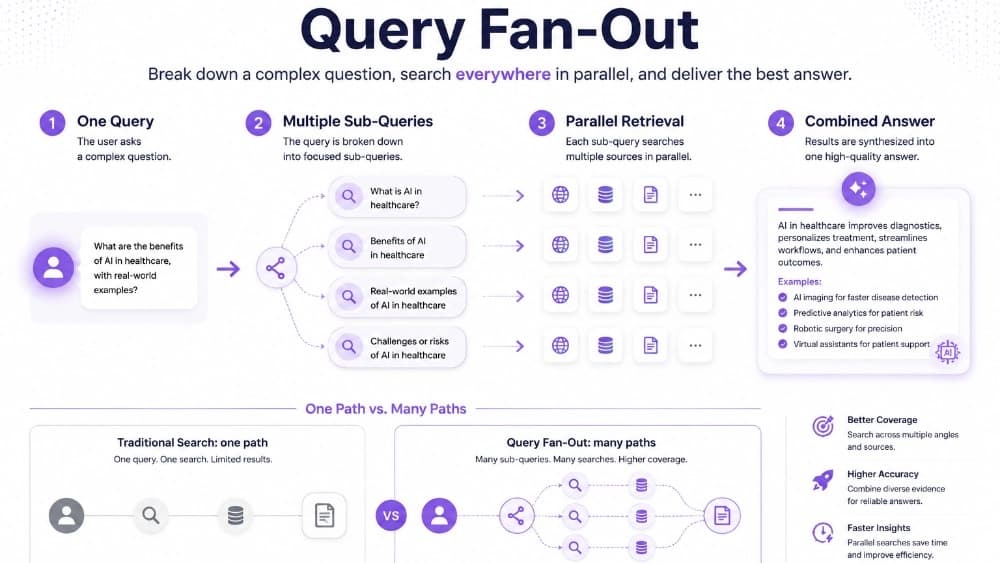
To better understand What is Query Fan-Out, we should also examine how it works. Behind the scenes, an intelligent search system usually goes through these steps:
1. Receive the original query
The system first receives the main query of the user. This query can be short, long, vague or specialized.
2. Query semantic analysis
At this stage, the system analyzes the language structure, user intent, entities, semantic relations and the final goal of the query.
3. Expand Query
This is where the concept of Query Fan-Out comes into play. The system divides the question into related sub-questions and branches. These branches may include the following:
- Definitions of concepts
- Comparisons
- Applications
- Advantages and disadvantages
- Examples
- Practical guidelines
- Related frequently asked questions
4. Retrieving information from multiple paths
Instead of searching based on a single phrase, the system looks for information through several sub-queries.
5. Combination of results
In the last step, the results collected from different branches are combined to make a more comprehensive answer.
This process shows exactly what Query Fan-Out is and why it plays a key role in AI-powered search.
What is the difference between Query Fan-Out and traditional search?
To better understand what Query Fan-Out is, it is useful to compare it to a traditional query.
Traditional search
In the traditional model:
- The focus was on keyword matching
- Each query was usually processed directly
- Results were mostly a list of links
- Coverage of complex intents was more limited
Query Fan-Out in Modern Search
But in the model Query Fan-Out:
- The question is broken into several different paths
- Multiple intentions are checked at the same time
- The answer can be mixed, multi-source and semantic
- The system tries to provide a more complete answer before clicking
So if we ask what is the main difference in Query Fan-Out, the answer is that in this model, the search is transformed from a simple linear matching to a network and multi-branch analysis.
What is the relationship between Query Fan-Out and SEO?
1. The importance of thematic coverage
2. The role of content structure
If you want to benefit from Query Fan-Out, you need to write your content with a clear and hierarchical structure:
- Main Title
- Subtitles
- Answers to Sub-Questions
- Examples
- FAQ
- Summary
This structure helps the system better identify which query branches your page is useful for.
3. Optimize for multiple intents
Knowing what a Query Fan-Out is shows you that each keyword may have multiple intents at the same time. Therefore, the content should inform, provide a comparison, and have a practical answer.
4. Increasing the chance of appearing in the results without clicking
In the world of Zero-Click Search, search engines may display the answer directly. Pages that are suitable for Query Fan-Out are more likely to be the source of these answers.
What is Query Fan-Out in AI Search?
For many digital marketing professionals, the most important question is what is the role of Query Fan-Out in AI Search. In AI-powered search engines, the final answer usually does not come from a single path. Intelligent systems try to break the question from different dimensions and create the final answer after various sources.
What is the role of Query Fan-Out in AI Search?
- Helps the model simplify the complex question
- Finds related subtopics
- Collects information from multiple sources simultaneously
- Helps build a comprehensive and user-centered answer
- Reduces the possibility of single-source error
For this reason, if we ask what Query Fan-Out is in the age of intelligent search, we must say that it is one of the main pillars of the retrieval and response architecture in AI Search.
What is a real example to better understand Query Fan-Out?
To better understand What is Query Fan-Out, let's consider a simple but real example.
Suppose the user searches:
"How to increase website sales with SEO?"
A system based on Query Fan-Out may split the query into the following branches:
- What is SEO?
- How does SEO affect sales?
- What is the role of technical SEO?
- How to improve conversion rates from organic input?
- How to produce content for business pages?
- How does local SEO help sales?
- How does E-E-A-T build trust?
Now suppose a page is written only about "Definition of SEO". This page only covers one branch. But a page that covers most of the above branches is more suitable for Query Fan-Out and has a higher chance of being seen.
How to optimize content for Query Fan-Out?
Now that we understand what Query Fan-Out is, we need to get to the practical part: how to optimize our content for it?
1. Write topic-oriented, not just keyword-oriented
Instead of just repeating the same phrase over and over again, cover the topic from different angles. This is what Query Fan-Out expects from the content.
2. Identify sub-intentions
For each main query, write user subqueries:
- What is it?
- Why is it important?
- How does it work?
- What are its advantages and disadvantages?
- What is its use?
- How is it different from similar concepts?
3. Use a professional heading structure
The structure of H1, H2 and H3 is very important if you want the search engine to understand which query branches your page is useful for.
4. Add FAQ
The FAQ section can cover a large part of the Query Fan-Out branches and create high SEO value.
5. Cover related entities and terms
In an article about Query Fan-Out, it is better to refer to concepts like:
- AI Search
- Semantic Search
- Intent Analysis
- Retrieval
- Topical Authority
- Zero-Click Search
Also mention.
6. Do not write incomplete answers
Surface content usually cannot perform well in a Query Fan-Out structure. The more comprehensive the answer, the higher the chance of being seen.
Benefits of Query Fan-Out for users and businesses
When we take a closer look at what Query Fan-Out is, we realize that this concept is not only important for search engines, but also has many benefits for users and brands.
Benefits for users
- Receive a more comprehensive answer
- Save time
- Reduce the need for multiple searches
- Better understanding of complex issues
Benefits for businesses
- Increasing the chances of appearing in smart results
- Improving the content strategy
- Strengthening the thematic validity of the site
- Increasing the probability of displaying the brand in combined answers
- More alignment with the future of SEO
What are the challenges and limitations of Query Fan-Out?
Besides the advantages, we should know the limitations of Query Fan-Out. Although this approach is powerful, it is not without challenges.
1. The possibility of deviation from the original intention
Sometimes breaking Query into different branches may cause the system to deviate a little from the user's main goal.
2. The need for deeper content
In the world of Query Fan-Out, weak and superficial content is less common. This creates a challenge for brands that do not have deep content.
3. More complexity in SEO
Before, it might have been enough to focus on a few keywords, but now you need to cover a network of topics and intentions.
4. Increasing competition for subject validity
The more search engines move towards Query Fan-Out, the more successful sites will be that are truly authoritative in a domain.
The future of Query Fan-Out in SEO and search
If we want to examine the future, we must ask what is the growth trend of Query Fan-Out and where will it go. Most likely, in the coming years, this concept will play a more prominent role in the following cases:
- Response Engines
- AI Overviews
- Search Generative Experience
- Smart Assistants
- Multi-Step Search
- RAG-Based Retrieval Systems
As search gets smarter, Query Fan-Out becomes more important. This means that search engines will try to analyze the question from different angles more than before and create the best answer by combining different information.
Therefore, brands that understand Query Fan-Out sooner and align their content strategy with it will have a greater advantage in the future of SEO.
جهت اطلاع از شرایط و هزینه ها کلیک کنید.

Summary: What is Query Fan-Out and why should we take it seriously?
- How to design the content structure
- Thematic coverage of the pages
- The chance of appearing in AI Search
- Presence in Zero-Click results
- Thematic credibility of the site
- Ability to respond to the complex intentions of users
Frequently asked questions about Query Fan-Out
1. What is Query Fan-Out?
Query Fan-Out is a process in which a main query is divided into several sub-queries and information paths to produce a more accurate and comprehensive answer.
2. Is Query Fan-Out only used in AI Search?
No, but it has become much more important in AI Search. Query Fan-Out plays a key role in modern search and advanced retrieval systems.
3. What is the relationship between Query Fan-Out and SEO?
Query Fan-Out makes search engines pay more attention to topic coverage, sub-intentions and depth of content instead of just focusing on a single keyword.
4. How to generate content for Query Fan-Out?
You should write structured, comprehensive and topic-oriented content that covers the user's main and secondary questions at the same time.
5. Does Query Fan-Out affect Zero-Click Search?
Yes, because in non-click results, search engines usually build the answer from several branches of information and Query Fan-Out plays an important role in this process.