

A comprehensive guide to increase site speed
In today's fast-paced digital world, time is gold. If your website cannot display your content to the user in a fraction of a second, not only will you lose potential customers, but you will also fall in Google rankings. This is where the concept of cache system comes in as a savior.
In this article from Behzi blog, we are going to comprehensively examine what system cache is, what is its importance and how types of cache can transform the performance of your website. If you own an online business or manage a digital platform, a proper understanding of caching and familiarity with types of caching is a necessity, not a choice!
What is the cache system?
To better understand the cache system, let's take a simple example. Let's say you go to a library and ask the librarian for a specific book on the history of the Internet. The librarian goes to the warehouse, searches the shelves and after 10 minutes brings the book to you. Now, if someone else wants the same book tomorrow, does it make sense for the librarian to go back to the warehouse? No! He keeps that book on his desk (nearest point) so that if asked again, he will deliver it in less than 5 seconds.
system cache does exactly that in the web and computer world. A system cache is a high-speed data storage layer that holds a subset of data that is temporarily cached. The main purpose of a cache system is to serve data to the user from a faster memory (such as RAM) when the same data is requested again, instead of calling it from the original source (which is usually slower, such as a database).
Therefore, using a powerful cache system reduces the load on the main server and greatly increases the response speed.
Why is it necessary to have a caching system for the website?
Before we examine types of cache, we should know why setting up a caching system is so important in SEO and business management:
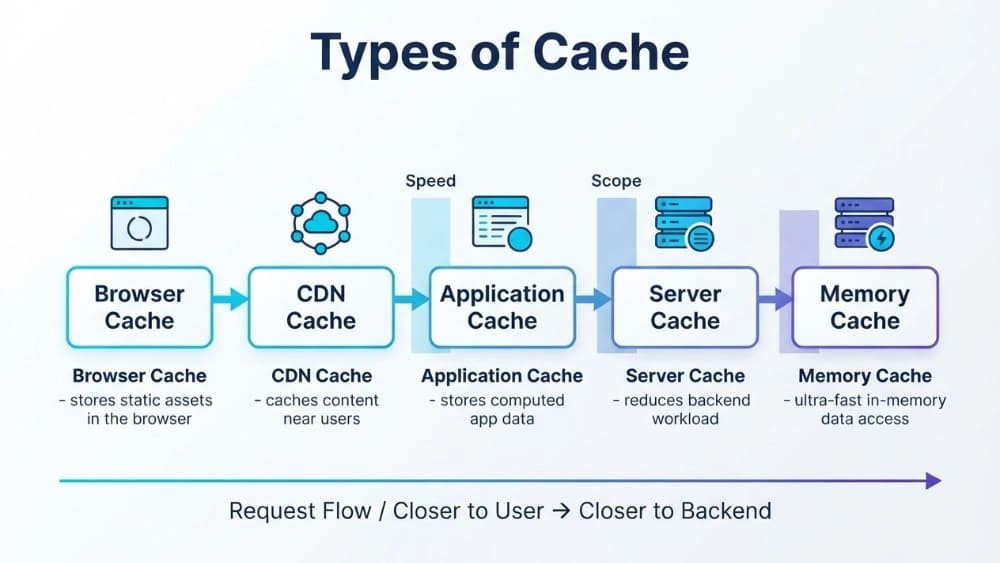
Comprehensive review of cache types (Types of Cache)
To fully optimize a website or application, you need to know that the system cache is not just a single button. Caching types are implemented in different layers of network infrastructure and software. Next, we examine the most important types of cache in detail:
1. Browser Caching
One of the most common types of cache is the browser cache. When a user lands on your website for the first time, their browser (such as Chrome or Safari) downloads your site's static files, including images, CSS files, JavaScript (JS) code, and logos.
In the browser cache system, these files are stored on the hard disk of the user's device. Therefore, when the user goes to another page of your site or visits the site again tomorrow, the browser does not need to download those files again. Correct setting of cache headers is very important in this cache system.
2. Page Caching
Page cache is one of the most effective types of cache for content management systems (CMS) like WordPress. Typically, when a user requests a page, the server must execute PHP code, connect to the database, retrieve the data, combine it with the template, and finally create an HTML file. This process takes time.
cache caches this entire HTML output after the first processing. Subsequent requests will receive the same prepared HTML file directly. Plugins like WP Rocket or LiteSpeed Cache use this type of system cache.
3. Object Caching
Among the types of cache, object cache is extremely important for store and dynamic sites. The object cache stores the results of database queries in the RAM of the server.
If your site has complex search or many products, this caching system prevents the server from plowing through the database for every small request! Two of the most famous technologies in this system cache are:
Redis: An advanced and very fast cache system that supports a variety of data structures.
Memcached: A classic and lightweight caching system for storing plain text data.
4. Content Distribution Network Cache (CDN Caching)
One of the most attractive types of cache in the network level is CDN Cache. Content distribution networks (like Cloudflare) have servers all over the world. This system cache stores copies of your site files on its local servers (for example in Europe, America and Asia).
When a user from Germany enters your site, which is on a server in Iran, the CDN cache system delivers the files to him from the German server. This less physical distance causes a sharp decrease in ping and an increase in load speed.
5. Opcode Caching
If your site is written in the PHP programming language, this cache is for you. PHP is an interpreted language; That is, its codes must be read and translated into machine code (Bytecode) every time it is executed.
Opcode cache system (like OPcache) keeps these translated codes in server memory so that there is no need to reprocess and translate PHP codes in subsequent requests. This is one of the most basic types of server-level cache.
6. Server-Side Caching
In addition to the above, web servers such as Nginx, Apache, and LiteSpeed have their own system cache that operates at the server layer. Combining server-side caches with software caches can bring you an incredibly fast site that can handle heavy traffic.
The effect of cache types on SEO strategy
You may ask what is the exact relationship between the cache system and SEO? Search engines like Google consider user experience (Core Web Vitals) as one of the most important ranking signals. Using cache types improves the following metrics:
* LCP (Largest Contentful Paint): A strong cache system (especially page cache and CDN) helps your largest page element to load very fast.
* FID / INP: By using the database layer cache system (Object Cache), the browser can respond to user interactions faster.
* TTFB: Reducing the time to receive the first byte of data from the server is possible only by activating a standard and optimized cache system.
* Crawl Budget: When your server responds faster thanks to caches, Google bots can index more pages of your site in less time.
Therefore, setting up and optimizing the cache system is not a luxury technical measure, but an integral part of the SEO strategy on the Behzi platform.
Fatal errors in system cache configuration
Despite all the mentioned advantages, incorrect use of cache types can have the opposite result. Here are some common mistakes in cache system implementation:
How to choose the best combination of cache types for your site?
Choosing the best Cash System totally depends on your infrastructure and type of business:
* For blogs and corporate sites: The combination of Page Cache and Browser Cache together with a Content Distribution Network (CDN) is quite sufficient and efficient.
* For online stores and high-traffic sites: You need a multi-layer caching system. In addition to the previous ones, you must use Object Cache (such as Redis) for the database, and more professional systems on the server side (such as Varnish or Nginx FastCGI Cache).
Our expert team at Behzi always customize the various cache architecture based on user behavior and exact server needs in implementing the "Business OS" (Business OS) for customers to achieve maximum efficiency.
conclusion
In this comprehensive guide, we take a detailed look at what the cache system is and how it works. We also learned about the most important types of cache, including browser cache, page cache, object cache, and CDN. Remember that system caching is a miracle tool that directly affects your SEO, user experience, and ultimately your revenue. Familiarity with cache types and their basic implementation can differentiate your website from your competitors in Google. If the speed of your site is slow, the main culprit is most likely the lack of a standard caching system or its misconfiguration. Check the status of your site's cache system today and enjoy the speed and power of this technology.