
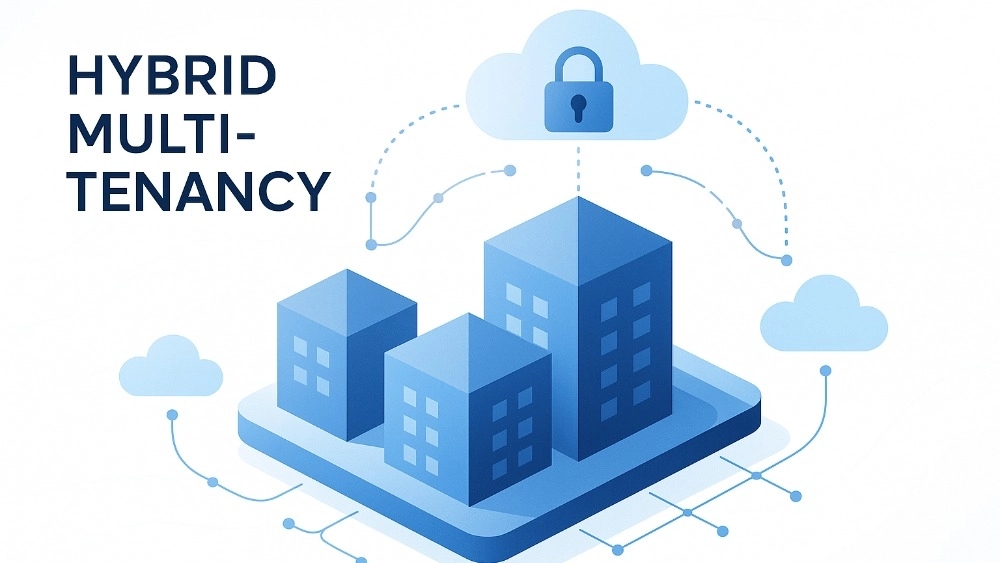
- In the modern world of the web, the concept of "hybrid multi-tenancy" has become one of the important infrastructures in the design and development of software, especially web-based software. In this article, we will carefully examine the concept of hybrid multi-tenancy, its difference from traditional models, and the advantages and challenges of this approach.
تماس فوری
What is hybrid multitenancy?
Hybrid Multi -Tension's Explanation with a Clear Example
- Traditional multitenancy models include two main types:
Shared multitenancy: All users use a shared infrastructure. Like a single database where different users store their data.
Dedicated multi-tenancy: Each user has a completely separate environment, like having a dedicated database.
Explanation of hybrid multitenancy with a clear example
- Example: online education platform
- Suppose you have an online education platform that serves universities, educational institutions and students. This platform uses hybrid multi-tenancy architecture. Now let's see how this architecture works:
1. Share public resources
- Some parts of the platform are common to all users. For example:
- General education courses that are the same for all universities and educational institutions.
- Main servers and software platform that users use.
- Tools such as electronic payment system or User Management sections.
- These sections are shared between Tennets (universities, educational institutions and users who are their sub-categories). In this way, the cost of public resources is reduced.
- 2. Separation of dedicated sections
- Some information or parts of the platform are specific to each Tennet (university or educational institution). For example:
- Each university or educational institution has its own database, so that the information of its users and students is stored separately from other universities.
- Settings and site design can be customized for each university. For example, the logo, brand name, and appearance of the platform for the first university are completely different from the second university.
- Sensitive information such as grades, user profiles, and learner data (students) are completely separate from other tennets.
تماس فوری
The difference between hybrid multitenancy and traditional multitenancy
1. More flexibility
- In traditional models, you either have to fully share resources or fully segregate them. In hybrid multi-tenancy, it is possible to set up more flexibility, so that parts of the infrastructure such as servers, applications or even database tables are shared among users, but sensitive data or specific parts are managed exclusively.
The benefits of multiplicity hybrids
- Dedicated models usually cost more because they require separate resources for each tenant. But in hybrid multi-tenancy, shared resources reduce some costs while providing full security and customization for sensitive parts.
3. Security and data isolation
- Data security in this type of architecture reaches a higher level due to the possibility of separating databases or sensitive parts from other tenants. This feature is especially necessary for organizations that have sensitive data.
Advantages of hybrid multitenancy
1. Reducing operating costs
- Using shared resources in parts of the system (such as servers or software) can reduce overall costs, especially in businesses that require both high security and resource efficiency.
- 2. High scalability
- Hybrid multi-tenancy allows for better scalability and more flexible designs. You can adjust only the required resources by increasing the number of users or tenants.
Hybrid applications
- Due to the separation of sensitive parts between tenants, this architecture has the ability to provide the highest level of information security.
4. Suitable for complex organizations
- Organizations that both need to share resources and separate certain departments can benefit from this model. For example, companies that provide cloud services and want to keep customer data separate while being multi-user.
Multi-tenancy hybrid applications
1. Cloud Services
- Companies that provide cloud services, such as AWS or Azure, can use this model to manage different customers.
- 2. Financial organizations
- Departments that need financial data security can isolate sensitive parts and share other parts.
How to optimize multiplayer hybrid?
- Online learning platforms that require user information (such as grades or profiles) to be managed separately, but share other parts of the system (such as courses).
4. Online stores
- Stores that offer different products to multiple groups of users can keep customer information separate and share common infrastructure such as payment processors.
How to optimize hybrid multitenancy?
1. Continuous management and monitoring
- Using monitoring tools such as monitoring and advanced dashboards is essential to prevent problems and improve performance.
- 2. Implementation of multi-layer security
- In the multi-tenancy hybrid architecture, data security should be multi-layered to prevent information leakage and intrusion.
3. Using microservice architectures
- Using microservices can add more flexibility and scalability to the system and improve resource management.
4. Focus on user experience
- Appropriate design and high speed of the system for users is the key to the success of this architecture.